Categories
Tags
-
#Waste Oil to Base Oil Plant
#Well Control Simulators
#HFO Visbreaking
#Transformer Oil BDV Tester
#VR Emergency Training Simulator
#SF6 Gas Purification Machine
#Laser Cleaning
#Automatic Laser Welder
#Benchtop Pneumatic Dot Peen Markers
#Oil Well Work
#Portable Well Control Simulators
#well logging
#Petroleum Engineering
#virtual reality emergency training simulator
#Well Control Simulator
#Waste Oil to Base Oil Plants
#Portable Simulator
#Web Guide Systems
#Floating Rig
#Turbine Oil Filtration
#Land Rig Installation
#Clothes Drop Boxe
#Industrial Garbage Compactor
#Magnetic Powder Brakes
#acuum Hydraulic Oil Filtration Technolog
#Mobile Waste Compactor
#Fracturing and Acidizing Simulator
#Trailer Purifier
Archives
Extending Oil Drains: How a Trailer Purifier Pays for Itself in
-
For fleet managers and industrial maintenance teams, the cost of lubricants is a relentless line item on the budget. Traditional "drain and fill" strategies are not only wasteful but incredibly expensive when you factor in the cost of new oil, disposal fees, and the labor hours required for the change. However, there is a solution that turns this operational expense into a capital saving: the trailer-mounted oil purifier.
By implementing a proactive oil maintenance program, companies are discovering that a mobile purifier doesn't just clean oil—it generates revenue by eliminating purchases. Here is how this equipment can pay for itself in as little as twelve months.
The Soaring Cost of "New" Oil
To understand the savings, you must first look at your current spend. Industrial lubricants and hydraulic oils have seen significant price volatility in recent years. Beyond the price per gallon of new oil, you must factor in the cost of hazardous waste disposal for the used oil. When you combine purchase price, disposal taxes, and the administrative overhead of ordering and stocking oil, the cost of a single oil change can be staggering. A trailer purifier allows you to break this cycle by restoring your existing oil to a "like new" condition indefinitely.
Calculating the ROI: A Real-World Example
Let’s look at a typical medium-sized industrial operation. Assume a facility uses 2,000 gallons of hydraulic oil annually. At a conservative cost of $12 per gallon for new oil, that is $24,000 in fluid purchases alone. Disposal fees might add another $3 per gallon, totaling $6,000. By using a trailer-mounted purifier to remove water, gases, and particulates, you can extend the drain interval by 300% or more.
If you eliminate just two of your four annual oil changes, you save $12,000 in oil and $3,000 in disposal costs—totaling $15,000 in year one. When you factor in the reduction in labor hours (no more filter changes, no more drain pans), many users find that their mid-range trailer purifier has effectively paid for itself within that first fiscal year.
The "Hidden" Savings: Uptime and Wear Reduction
While the direct oil savings are impressive, the real financial impact lies in machine reliability. Clean oil is the lifeblood of your machinery. When a purifier removes abrasive particles and corrosive acids, component wear slows dramatically. This means fewer unexpected breakdowns, reduced seal failures, and extended life for expensive components like pumps and bearings. When your trailer purifier prevents just one catastrophic hydraulic pump failure, that avoidance alone can often cover the cost of the purification equipment.
Mobility: The Force Multiplier
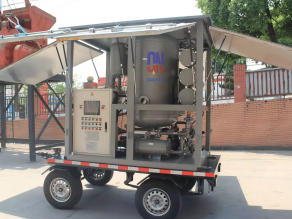
The "trailer-mounted" aspect of the purifier is the final piece of the financial puzzle. Because the unit is mobile, one machine can service an entire fleet or multiple plant locations. Instead of buying stationary units for every piece of heavy equipment, you simply tow the purifier to the machine. This high utilization rate accelerates your return on investment, allowing you to justify the purchase based on the collective savings across multiple departments, rather than just one.
Conclusion
Extending oil drains is not just about being frugal; it is about being resource-efficient. By investing in a trailer-mounted oil purifier, you transform waste into a reusable asset. With direct oil savings, reduced downtime, and the flexibility of mobility, achieving a full return on investment within one year is not just a possibility—it is a predictable outcome for savvy maintenance teams.