Categories
Tags
-
#Image & Video FullScreen Background WordPress Plugin: A Developer's Deep Dive & Technical Review Creating an immersive first impression on a website often comes down to visuals. While clean
#minimalist designs have their place
#sometimes you need to hit the user with a full-blast
#edge-to-edge visual statement. This is where full-screen backgrounds come into play. They can set a mood
#showcase a product
#or create a cinematic experience that static layouts simply can't match. The challenge
#however
#has always been implementation. Wrestling with CSS
#ensuring responsiveness
#and fighting theme conflicts can turn a simple design idea into a development nightmare. This is the problem the Image&Video FullScreen Background WordPress Plugin aims to solve. In this technical review and guide
#Building an e-commerce website for a highly specialized and regulated industry like firearms is not for the faint of heart. You're not just selling t-shirts; you're dealing with complex product specifications
#a discerning customer base that values precision
#and the constant need to project an image of professionalism and trust. Into this challenging space steps the Range - Weapon Shop & Gun Store WordPress Theme
#a product that aims to be a turnkey solution for online gun stores
#shooting ranges
#and tactical gear suppliers. But in a world of multipurpose themes
#does a niche-specific tool like this actually hit the target
#or does it misfire under the pressure of real-world development? As a developer who has navigated the murky waters of niche e-commerce
#I'm putting Range through its paces to see if it’s a precision instrument or just a generic template in tactical camouflage. First Impressions: Aesthetics and Demo Analysis Loading up the demo for the first time
#Range immediately establishes its intended atmosphere. The design language is unapologetically masculine and rugged
Archives
EduAI Flutter App Review: A Developer's Deep Dive into the AI H
-
EduAI Flutter App Review: A Developer's Deep Dive into the AI Hype
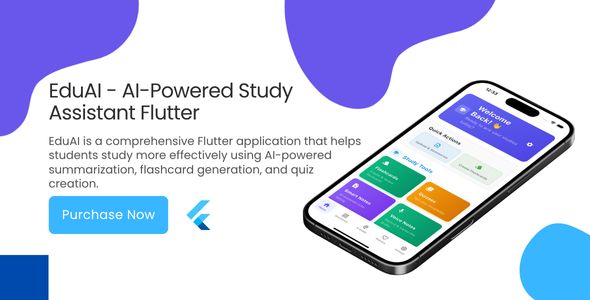
The gold rush in educational technology is deafening. Every week, a new app promises to revolutionize learning with the magic pixie dust of "AI". Most are thin wrappers around an OpenAI API key, sold with slick marketing and grand promises. So, when a full-source Flutter application like the EduAI - AI-Powered Study Assistant - Smart Summaries, Flashcards, and Quizzes (Flutter App) lands on my desk, my skepticism is already at DEFCON 2. Is this a genuine toolkit for building a viable EdTech business, or just another codebase destined to become digital shelfware? I acquired the package from gpldock, a repository known for offering GPL-licensed software, and spent a weekend tearing it apart. This is not a sales pitch; it's an autopsy from a developer who has seen too many "turnkey solutions" turn into project-ending nightmares.
Part 1: The Promise vs. The Code - A Reality Check on Features
EduAI sells itself on a trifecta of AI-driven features: Smart Summaries, Flashcards, and Quizzes. The premise is simple: feed it text, a PDF, or even a YouTube link, and it generates study materials. Let's dissect each promise and see what's actually happening under the hood.
The "Smart" Summarizer: An API Call in Disguise
The core value proposition here is turning dense material into bite-sized summaries. I tested this by feeding it a 15-page academic paper on memory consolidation in neural networks. The app churned for about 20 seconds and produced a five-paragraph summary.
The Good: The summary was coherent and captured the main points surprisingly well. It correctly identified the abstract, methodology, and conclusion, rephrasing them into simpler language. For a high-school or early undergraduate student, this is genuinely useful. It’s faster than reading the whole paper and better than just reading the abstract.
The Technical Reality: Digging into the code reveals exactly what I suspected. The app's `AIService.dart` (or a similarly named file) is a straightforward HTTP client. It takes the input text, packages it into a JSON payload, and sends it to an API endpoint—likely OpenAI's GPT-3.5 or GPT-4. The "magic" is a well-crafted prompt, something along the lines of:
"Summarize the following text for a university student. Focus on the key arguments, evidence, and conclusions. Format the output into clear paragraphs: [TEXT HERE]".The problem isn't that it uses an API; the problem is the lack of sophistication. There's no chunking for large texts, which means feeding it a full book will cause the API call to fail due to token limits. There’s no apparent mechanism for adjusting the summary's complexity or length, a feature that would have added real value. Most critically, the cost implication is completely ignored at the application level. Every summary costs money. A user summarizing a few book chapters could quickly run up a multi-dollar API bill. The business model is on you, the developer, to figure out. The app just makes the calls.
Flashcards and Quizzes: Intelligent Generation or Keyword Extraction?
Next, I tasked EduAI with creating flashcards and a quiz from a chapter about the causes of World War I. This is where the "AI" claim gets tested more rigorously. Simple summarization is one thing, but generating meaningful questions and answers requires a deeper level of comprehension.
The Good: The app successfully generated 15 flashcards and a 10-question multiple-choice quiz. The questions were relevant, touching on the key alliances, events like the assassination of Archduke Franz Ferdinand, and underlying concepts like militarism and imperialism. For quick revision, it works. It's better than manually creating flashcards, at least in terms of speed.
The Technical Reality: The prompt engineering here is a bit more advanced, but still transparent. The app likely sends a prompt like:
"From the text provided, generate 10 multiple-choice questions with four options each. The questions should test understanding of the main concepts. Also generate 15 'front/back' flashcards based on key terms and definitions. Format the output as a JSON object with a 'quiz' array and a 'flashcards' array: [TEXT HERE]". The app then parses this JSON to populate the UI.The "intelligence" is entirely dependent on the large language model (LLM) at the other end of the API call. The app itself is just a dumb terminal. I noticed some quirks. The quiz occasionally generated distractors (incorrect answers) that were absurdly wrong, making the correct answer obvious. The flashcards sometimes picked up trivial details while missing more significant concepts. This isn't the app's fault, but rather a limitation of the LLM's "one-shot" generation. A more robust system might use a multi-step process: first identify key concepts, then generate questions for each, and finally validate them. EduAI does not do this. It’s a fire-and-forget operation.
Part 2: Under the Hood - A Flutter Developer's Autopsy
A pretty UI can hide a multitude of sins. For a developer buying this codebase, the architecture, code quality, and customizability are what truly matter. This is where the value is either created or destroyed.
The Tech Stack: A Standard But Potentially Flawed Foundation
- Flutter & Dart: The choice of Flutter is pragmatic. You get a single codebase for Android and iOS, with a fast, declarative UI framework. The Dart code itself is a mixed bag. Some parts are clean and follow modern conventions with null safety properly implemented. Other parts, especially in the UI widgets, feel rushed. I found several large widget classes doing far too much—fetching data, managing state, and building UI all in one place. This is a classic sign of a developer working against the framework rather than with it, and it makes future modifications a real pain.
- State Management: EduAI appears to use the Provider package for state management. Provider is a solid, respectable choice, but the implementation here is patchy. In some areas, it’s used correctly to provide services and models down the widget tree. In others, I saw rampant use of
StatefulWidgetandsetState()for complex screen state, leading to inefficient rebuilds and potential bugs. It feels like the developer understood Provider but didn't commit to it fully, creating a hybrid system that's confusing to navigate. A developer taking over this project would need to spend significant time refactoring state management to a consistent pattern (whether it's Provider, BLoC, or Riverpod) to make it scalable. - Dependencies (`pubspec.yaml`): Scrutinizing the dependencies file is like running a background check. EduAI uses a fairly standard set of packages:
httpfor network calls,firebase_coreand its cousins for the backend,flutter_pdfviewfor displaying PDFs, andprovider. The good news is that I didn't spot any obviously deprecated or abandoned packages. The bad news is that versions were pinned loosely (e.g.,^1.2.3), which can be a time bomb. A futureflutter pub getcould pull in a new, breaking version of a dependency and shatter the build. A professional project should use a lockfile and more precise version pinning to ensure reproducible builds.
Architecture and Rebranding Headaches
The project structure follows a basic feature-first approach (e.g., folders for `summarizer`, `quiz`, `profile`), which is decent. There's a `services` directory for things like API calls and a `models` directory for data structures. So far, so good.
The real issue is customizability. If you want to white-label this app, you're in for a rough ride. While some core configuration like the API endpoint is in a `config.dart` file, many other things are not.
- Hardcoded Strings: I found UI strings like "Generate Summary" and "My Quizzes" hardcoded directly in `Text()` widgets. This is a cardinal sin of app development. Proper internationalization (i18n) using ARB files is completely absent. To translate this app or even just change the button text, you'll need to go on a treasure hunt through dozens of files.
- Styling: Colors and themes are a mess. While a primary `ThemeData` object exists, many widgets have their colors, fonts, and padding hardcoded inline. Changing the app's primary color from blue to green would require a project-wide search-and-replace, and you'd inevitably miss a few spots. This severely limits the "turnkey" value. A proper implementation would have all colors, text styles, and spacing defined in a central theme file.
- API Swappability: The `AIService.dart` file makes direct calls to a specific API format. If you wanted to switch from OpenAI to Google's Gemini or a self-hosted model, you would have to rewrite the service logic entirely. A better architecture would use an abstract `AIProvider` interface, with concrete implementations like `OpenAIProvider` and `GeminiProvider`. This would allow you to switch AI backends by changing a single line of code in your configuration, but that foresight is missing here.
Part 3: The Installation Gauntlet - A Step-by-Step Guide
Getting this app from a ZIP file to a running debug build was an exercise in patience. It's doable, but not without hitting some common potholes. Follow this guide, and you might save yourself a few hours of frustration.
Step 1: The Prerequisites (Don't Skip This)
- Flutter SDK: You need a working Flutter installation. I used version 3.16. If you're not set up, go to the official Flutter docs. Once installed, run
flutter doctorin your terminal. Do not proceed until it shows all green checkmarks (or at least no critical errors for your target platform). - IDE: Use Visual Studio Code with the Dart and Flutter extensions or Android Studio. This is not negotiable. They provide the debugging and analysis tools you will absolutely need.
- Firebase Account: The app uses Firebase for user authentication (Email/Password, Google Sign-In) and likely Firestore to save user-generated content like quizzes and summaries.
- Go to the Firebase console and create a new project.
- Enable Authentication (Email/Password and Google methods).
- Enable the Firestore Database.
- Register an Android app and an iOS app within the project. Follow the on-screen instructions carefully. This is where people mess up. For Android, the package name (`com.example.eduai`) must match what's in your `AndroidManifest.xml` and `build.gradle` files.
- Download the `google-services.json` file for Android and the `GoogleService-Info.plist` file for iOS. These are your keys to the Firebase kingdom.
- AI API Key: Sign up for an OpenAI account (or whichever LLM you plan to use). Generate an API key. DO NOT, UNDER ANY CIRCUMSTANCES, COMMIT THIS KEY TO YOUR GIT REPOSITORY.
Step 2: Project Setup and Configuration
- Unzip and Place Files: Unzip the source code. Place the `google-services.json` file you downloaded into the `android/app/` directory. Place the `GoogleService-Info.plist` file into the `ios/Runner/` directory (you'll need to open the iOS project in Xcode to add it correctly).
- Configuration File: Find the configuration file, likely named `lib/core/config.dart` or something similar. Open it. This is where you need to add your AI API key. The code will probably have a placeholder like
final String apiKey = "YOUR_API_KEY_HERE";. Replace the placeholder. For a real production app, you should load this from environment variables using `dart-define`, not hardcode it. But for a debug build, this will get you running. - Open in IDE and Get Dependencies: Open the project's root folder in VS Code or Android Studio. The IDE should prompt you to get dependencies. If not, open a terminal in the IDE and run
flutter pub get. This will download all the packages listed in `pubspec.yaml`. Expect a few minutes of downloading.
Step 3: The Build and The Bugs
- First Run (Android): Connect an Android device or start an emulator. Try to run the app in debug mode (F5 in VS Code). This is where you'll likely hit your first error.
- Gradle Error: A common failure point. The error might be about a version mismatch in the Android Gradle Plugin or a missing dependency. Open `android/build.gradle` and `android/app/build.gradle`. Check that the `compileSdkVersion` and `minSdkVersion` make sense. You may need to update Gradle versions to match your system's setup. This is more of an art than a science. Google the error message; you're not the first person to see it.
- Multidex Error: If the app has many methods (and Flutter apps often do), you might need to enable Multidex. In your `android/app/build.gradle`, add `multiDexEnabled true` to the `defaultConfig` block.
- First Run (iOS): Running on iOS requires a Mac with Xcode.
- Open the `ios` folder in your project as a workspace in Xcode (`.xcworkspace`, not `.xcodeproj`).
- In Xcode, set your developer team for signing.
- You will almost certainly have to run
pod installorpod updatefrom the `ios` directory in your terminal. CocoaPods, the iOS dependency manager, can be finicky. If you get errors, deleting the `Podfile.lock` and running `pod install --repo-update` can sometimes work miracles.
- Moment of Truth: Once you've appeased the build gods for both platforms, the app should launch. You'll see a splash screen, then likely a login/register page. Test the Firebase authentication by creating an account. Then, try the core features. Paste some text and try to generate a summary. If it works, congratulations. If you get an API error, double-check that you placed your API key correctly and that your OpenAI account is active and has credits.
The Verdict: Is EduAI a Launchpad or a Landmine?
After a full technical review, EduAI is neither a golden ticket nor a complete scam. It sits in a complicated middle ground. It's a functional prototype, not a production-ready, white-label solution.
For the Entrepreneur with No Code Skills: Stay away. You cannot buy this, change the logo, and launch a business. The hidden running costs of the API calls will eat you alive, and you lack the technical ability to implement the necessary subscription models, rate limiting, and optimizations required to run a sustainable service.
For the Junior Flutter Developer: This could be a dangerous learning tool. You'll see some good patterns and some very bad ones. If you buy this, treat it as a case study. Your first task should be to refactor the state management into a consistent pattern and externalize all hardcoded strings and styles into a theme file. Don't even think about launching it as-is.
For the Senior Web Developer or Experienced Flutter Developer: This is where EduAI might have some value, but not as a turnkey solution. Think of it as buying a partially completed house. The foundation is poured, and the framing is up (Flutter, Firebase integration, basic UI), but the wiring is a mess, the plumbing is questionable, and there's no insulation. You can use this as a starting point to save a few weeks of initial setup. You'll immediately want to gut the state management, implement a proper theming system, and build a robust, cost-aware service layer for the AI features. You have the skills to fix its flaws and build upon its foundation.
Ultimately, products like EduAI reflect a broader trend in the software world, similar to what we see with the vast libraries of assets like Free download WordPress themes and plugins. They provide immense starting value but are not a substitute for genuine engineering skill. EduAI is a good skeleton. It has bones and a basic structure. But it's up to you, the developer, to give it a heart, a brain, and a nervous system that can actually survive in the wild.