Categories
Tags
-
#hot stamping foil slitting machine
#ribbon slitting machine
#ribbon slitter
#thermal transfer ribbon slitting machine
#barcode ribbon slitting machine
#foil slitter
#hot foil slitting machine
#plastic film slitting machine
#hot stamping foil slitter
#ribbon slitter machinbe
#carbon ribbon slitting machine
#pet film slitting machine
#high-speed film slitting machines for BOPP
#PET
#PVC
#PET film slitting machines
#printers ribbon slitting machine
Archives
PET Film Slitting Machine Selection Guide
-
Posted by delish xiamen Filed in Arts & Culture #plastic film slitting machine #pet film slitting machine #high-speed film slitting machines for BOPP #PET #PVC 3 views
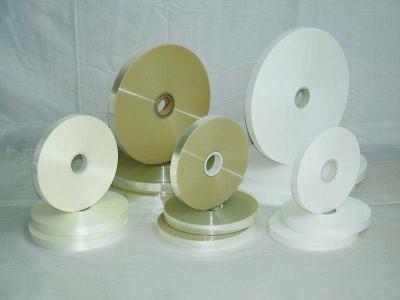
In high-end manufacturing fields such as optoelectronics, packaging, and insulation materials, PET film (polyester film) has become an indispensable basic material due to its excellent mechanical and optical properties. However, from wide master coils to narrow finished products suitable for downstream production, slitting and rewinding is the last key process that determines product quality and production costs.
In the face of the multi-functional slitting machine models on the market, how to choose a model to avoid the dilemma of "the equipment you buy is not used, and the equipment used is inefficient". This article will provide an in-depth analysis of the characteristics of PET film and dismantle the five core functional modules that affect production efficiency.
1. Understand your "opponent"
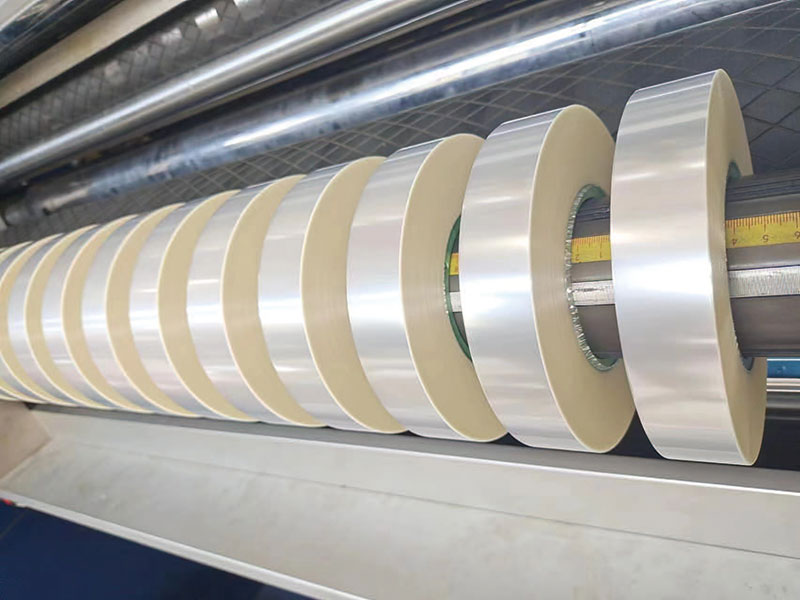
 the difficulty of slitting ET film
The first step in selecting a model is not to look at the machine, but at the material. PET films often have the following properties, which place special demands on slitting equipment:
1. High hardness and stiffness: Compared to BOPP (biaxially stretched polypropylene film) film, PET has a higher modulus, which requires stronger traction and more precise tension control, otherwise it is easy to slip or tensile deformation.
2. Wide Thickness Range: From ultra-thin films of 3-6μm for capacitors to thick films of 250-350μm for touch screens, the thickness span is extremely large. A good machine must be able to cover a wide range of thicknesses without cracking or creasing.
3. High surface value: Many PET films (such as optical films, release films, hardened films) have extremely expensive and fragile surface coatings. Any minor scratches or dust contamination during slitting can result in the scrapping of the entire roll.
Conclusion: The core logic of PET slitting machines is to "achieve the most accurate cutting with the gentlest tension at high speed".
2. Five key functions that determine efficiency and quality
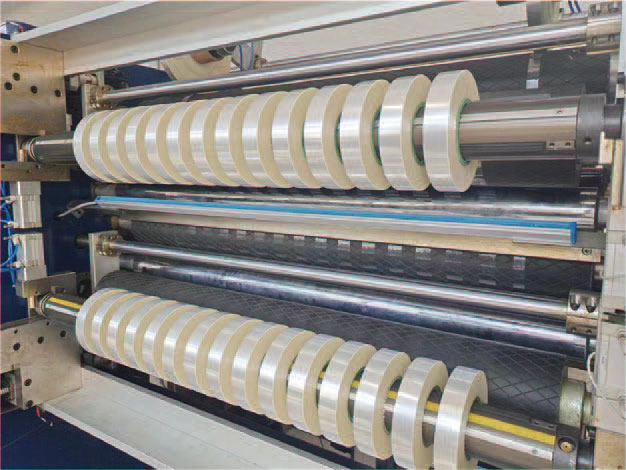
During the selection process, it is important to focus on the configuration of the following five technical dimensions:
1. Rewinding and unwinding structure: a leap from a single axis to fully automatic
The most intuitive manifestation of production efficiency is the roll change time.
• Basic type (manual/semi-automatic): suitable for small batches and multiple batches of sample preparation. When a roll is slit, it needs to be manually stopped to change the roll, which takes about 3-5 minutes.
• High efficiency (automatic reel change/double station): For high-volume production, a model with automatic film bonding or a two-station turret must be selected. The equipment can automatically cut off and paste new rolls at full speed (such as 300m/min) to achieve "zero downtime" rewinding. This increases effective production time by more than 30%.
2. Tension Control System: The Lifeline of PET Film
If the tension is too large, the film will produce longitudinal stretching (MDO direction), resulting in excessive shrinkage; If the tension is too small, wrinkles or uneven retraction will occur.
• Closed-loop control: A closed-loop PID control system with imported tension sensors must be selected.
• Multi-stage independent control: According to the creep characteristics of PET, each section of unwinding, traction and rewinding must be controlled independently, and has the function of taper tension. With the increase of the roll diameter, the tension should decrease in taper to ensure that the internal and external tension of the finished roll is consistent and avoid deformation after storage.
3. Cutting method: Good cutting is the last word
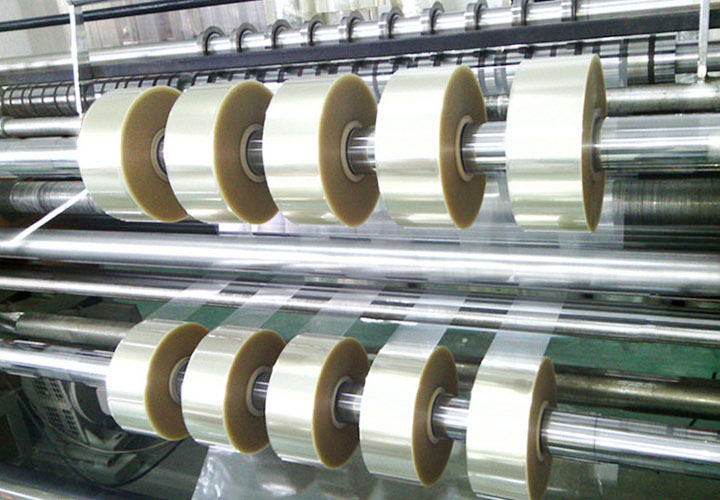
PET film is usually slitted in two ways:
• Razor blade cutting (grooving/hanging): suitable for films with a thickness of less than 50 μm. The advantage is that it is convenient to change orders, but the disadvantage is that it is easy to generate dust and is not suitable for thick films.
• Circular knife shearing: suitable for medium and thick films, or optical-grade films with extremely high dust requirements. The upper and lower disc cutters cut the material like scissors, and the cut is smooth and dust-free.
◦ Selection suggestion: If your business involves high-end optical films or thick films, please give priority to pneumatic circular knives made of imported materials, although the initial investment is high, but the long-term yield rate benefits far exceed the equipment price difference.
4. Dust and static removal: standard for optical grades
PET film is the "hardest hit area" of static electricity, which not only causes winding deviation, but also adsorbs dust and causes coating defects.
• Static electricity removal: The equipment must be equipped with active ion air rods, which are best arranged in multiple places before winding and after unwinding.
• Dust removal: High-end models should include contact dust rollers or non-contact dust removal mechanisms, with dust-free covers, to ensure that the slitting environment reaches a cleanliness of more than 10,000 levels.
5. Automation and intelligence: Reduce dependence on people
Labor is the biggest destabilizing factor.
• Automatic tool rowing system: When changing specifications in traditional slitting machines, workers need to manually adjust the tool position, which is time-consuming and inaccurate. The automatic tool rowing system can automatically complete the tool positioning within a few minutes through program control, with an accuracy of up to ±0.1mm.
• MES system interface: Modern factories need data. When selecting, ensure that the equipment has an open data interface, which can upload vehicle speed, meters, and alarm information in real time to realize digital traceability of the production process.
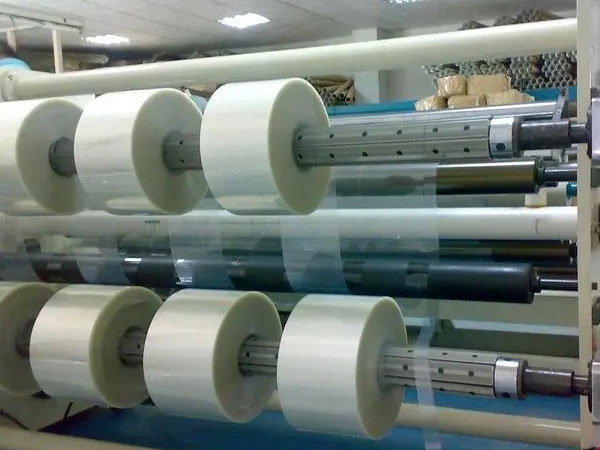
3. Selection and pit avoidance guide: match your real needs
After understanding the above functions, you need to make trade-offs based on your business positioning:
• Scenario A: General purpose packaging printing
◦ Demand: large volume, low requirements for trimming, cost sensitive.
◦ Configuration suggestion: Center winding or center/surface gap winding model can be selected, and the blade cutting is used to maximize speed.
• Scenario B: Electronic/optical grade films
◦ Requirements: High cleanliness, no scratches, no warping, and the end face is as flat as a mirror.
◦ Configuration suggestion: The center/surface winding model must be selected, with imported circular knives, and the static elimination and dust removal module must be strengthened. The winding roller needs to use special rubber material to prevent crushing the film.
• Scenario C: Thick PET/insulation
◦ Requirements: Hard material, large winding, large torque.
◦ Configuration suggestion: The spindle diameter needs to be enlarged, and the high-power servo motor drive is used to ensure stability under low-speed and high-torque conditions.
4. Summary
The PET film slitting machine is not only a tool for cutting large rolls into small rolls, it is a precision equipment that integrates tension control, motion control, and dust control.
When selecting, don't just compare the size and speed on the quotation, but also ask: "What are the special solutions for the static electricity and hardness of PET film in this equipment?" ”
Correct selection can increase production efficiency by 50% and reduce defect rate by 80%. Only by deeply binding the key functions of the equipment to its own product positioning can we keep the last line of defense for profits in the fierce market competition.