Categories
Tags
Archives
SF6 Gas Purification: The Cornerstone of Sustainable Switchgear
-
The global push to mitigate climate change has placed sulfur hexafluoride (SF6)—a potent greenhouse gas—under intense regulatory scrutiny. The EU’s F-gas Regulation, which implements a phased SF6 gas ban in switchgear starting in 2026, has highlighted a critical reality: the future of SF6 lies not in virgin production but in recycling and purification. SF6 gas purification, a process that restores contaminated or aged gas to near-virgin quality, has emerged as the cornerstone of sustainable switchgear operations, enabling utilities to comply with regulations, reduce costs, and extend the lifespan of existing assets.
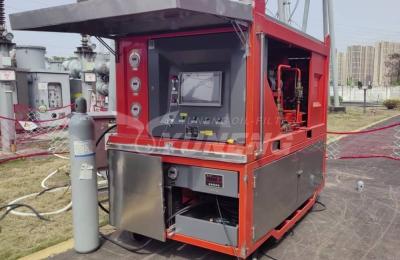
SF6 gas purification addresses the inherent challenge of used SF6: over time, gas in electrical equipment accumulates moisture, oil contaminants, dust, and acidic decomposition products (such as SOF₂ and HF) from normal operation and electrical arcing. These impurities degrade the gas’s insulating and arc-quenching properties, increasing the risk of equipment failure and rendering the gas unsuitable for direct reuse. SF6 gas purification machines tackle this issue through advanced multi-stage processes, integrating technologies such as molecular sieves for moisture removal, activated alumina and carbon for acidic byproducts, and cryogenic liquefaction for separating SF6 from air and other non-condensable gases. YUNENG’s purification machines, for example, use filters from Japan’s CKD Company and high-efficiency adsorbents, ensuring exceptional purification without frequent adsorbent replacement.
The technical specifications of modern SF6 gas purification systems are tailored to meet the stringent requirements of post-2026 regulations. Purified gas must achieve a purity of ≥99.9% by weight, with water content ≤60 PPM/V and oil content ≤5 PPM/W—standards that align with the EU’s mandate for recycled gas in maintenance. These systems also incorporate closed-loop compressor systems to prevent leaks, a critical feature given SF6’s high GWP. The vacuum system, equipped with two-stage rotary vane pumps and automatic oil return prevention, ensures that equipment is thoroughly evacuated before refilling, minimizing residual gas and emissions. With a limit vacuum of ≤10 Pa, these machines exceed the performance requirements for zero-emission operations, supporting utilities in meeting environmental audits.
Beyond compliance, SF6 gas purification delivers tangible economic benefits. For high- and extra-high-voltage switchgear, which can contain large volumes of SF6, refining and reusing gas reduces lifecycle costs by 40-70% compared to purchasing virgin gas. This is particularly impactful as the EU ban restricts access to new SF6 post-2035. Additionally, purification extends the operational life of switchgear by ensuring consistent gas quality, reducing the need for premature equipment replacement. For industries such as power supply bureaus, transmission and distribution companies, and hydropower departments—key users of SF6 purification machines—this translates to improved reliability and reduced capital expenditure.
The role of SF6 gas purification is further amplified by the EU’s focus on digital compliance. Modern purification machines integrate mass flow meters and electronic weighing systems with ±0.1 kg accuracy, automatically logging purification data for audit purposes. This digital layer transforms gas handling from a maintenance task into a regulated, traceable process, ensuring utilities can demonstrate compliance with ease. As voltage classes become subject to the ban—from medium voltage (≤24 kV) in 2026 to extra-high voltage (>145 kV) in 2032—purification systems will need to scale to meet diverse needs, from compact on-site units for medium-voltage equipment to industrial-grade systems for large transmission substations.
In a world moving toward decarbonization, SF6 gas purification is more than a technical solution—it is a commitment to sustainable resource management. By restoring used SF6 to optimal quality, utilities can continue to rely on existing switchgear assets while minimizing their environmental impact. As regulations evolve and the demand for circular economy practices grows, SF6 gas purification will remain an essential tool for balancing operational efficiency, regulatory compliance, and climate responsibility.