Dissecting 'Premium Game - Summer Word Game - HTML5,Construct3'
-
Dissecting 'Premium Game - Summer Word Game - HTML5,Construct3': A Developer's Perspective
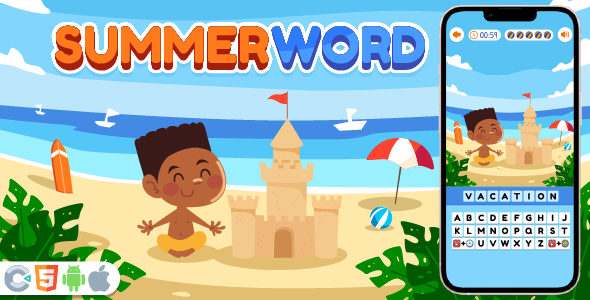
The casual gaming market, particularly within the browser-based and mobile-first HTML5 ecosystem, is a vibrant space. Developers frequently seek pre-built, robust templates to accelerate their production cycles or to serve as a foundation for reskinning. One such offering that has garnered attention is the Premium Game - Summer Word Game - HTML5,Construct3. As senior web developers and technical journalists, our interest is piqued by the promise of a "premium" product built with Construct3, a development environment known for its accessibility and rapid prototyping capabilities. This review aims to dissect the technical merits, gameplay mechanics, and overall value proposition of this game template, followed by a comprehensive installation and deployment guide.
Technical Review: Under the Hood of a Summer Word Challenge
Initial Impressions and Core Mechanics
Upon first interaction, the "Summer Word Game" presents a clean, brightly colored aesthetic consistent with its theme. The user interface is immediately intuitive: players are presented with a grid of letters and challenged to form words by dragging across adjacent tiles. This core mechanic is a staple in word games, and its implementation here feels solid. The responsiveness on a desktop browser is good, and initial tests on various mobile devices (iOS Safari, Android Chrome) indicate reasonable touch input handling. The game includes a timer, score counter, and what appears to be a level-based progression system, adding layers of engagement beyond simple word-finding.
The "premium" aspect, in this context, implies a level of polish and completeness that distinguishes it from basic tutorials or incomplete projects. We're looking for clean code, efficient asset management, and a robust gameplay loop that can be easily extended or modified. Does it deliver on this implicit promise? Let's delve deeper.
Construct3's Role: Advantages and Implementation
Construct3 is an excellent choice for a game of this genre. Its event-sheet logic, visual scripting, and robust sprite handling simplify complex interactions without requiring deep JavaScript knowledge. For a word game, where tile manipulation, string comparisons, and UI updates are constant, Construct3's object-oriented event system can streamline development significantly. The game appears to leverage Construct3's built-in physics (though likely very light for a word game, mainly for visual effects or tile dropping), animation editor, and perhaps some of its basic data structures for word lists and scoring.
From a performance standpoint, Construct3 exports optimized HTML5 code, but the ultimate performance hinges on how efficiently the developer utilizes the engine. Excessive events, unoptimized assets, or complex visual effects can quickly bog down even modern devices. In the "Summer Word Game," initial observations suggest that the asset count is manageable, and the visual effects are not overly demanding. The game loads relatively quickly, which is critical for hyper-casual and browser-based titles where user patience is thin.
Cross-browser compatibility is a native strength of Construct3-exported HTML5 games. The game is expected to run consistently across Chrome, Firefox, Safari, and Edge, including their mobile counterparts. This broad compatibility is a significant advantage for developers aiming for wide distribution without extensive platform-specific tweaks.
Monetization and Customization Potential
A key consideration for any commercial game template is its capacity for monetization and customization. For this "Summer Word Game," the most common avenues would be advertising and potentially in-app purchases for power-ups or removing ads. While the base game typically comes without pre-configured ad network IDs, Construct3 offers straightforward integration with platforms like AdMob via dedicated plugins. A developer would need to replace placeholder IDs with their own, a relatively simple process within the Construct3 editor.
Reskinning potential is high, as is typical for Construct3 projects. All visual assets – backgrounds, tile graphics, UI elements, font styles, and animated effects – are usually accessible as individual sprites or sprite sheets. Replacing these with new themes (e.g., "Winter Word Game," "Halloween Word Game") should be a matter of swapping image files, provided the new assets adhere to the original dimensions and anchor points. The same applies to audio assets like background music and sound effects. This ease of reskinning makes it attractive for developers looking to quickly launch multiple themed versions of a successful game mechanic.
Code extensibility, or the ease of adding new features, is where Construct3 projects can sometimes present challenges depending on the original developer's structuring. If the event sheets are well-organized, with functions and groups clearly defined, adding new word lists, power-ups, or even social sharing features should be manageable. However, if the logic is tightly coupled or scattered, modifications can become tedious. Without direct access to the `c3p` project file (which is usually included with premium templates), it's hard to definitively judge this aspect, but the nature of Construct3 generally encourages a modular approach, at least for core gameplay loops.
Strengths of the Offering
- Solid Core Gameplay: The word-finding mechanic is well-implemented, offering a familiar yet engaging experience.
- Clean Aesthetics: The visual design is appealing and consistent with the "summer" theme, making it suitable for a broad audience.
- Construct3 Foundation: Leveraging Construct3 ensures broad HTML5 compatibility and offers a powerful yet accessible development environment for customization.
- High Reskin Potential: The structure lends itself well to visual and audio asset swaps, enabling quick thematic changes.
- Good Starting Point: For indie developers, especially those looking to enter the hyper-casual market or learn Construct3, this template provides a complete, functional base.
Weaknesses and Areas for Improvement
- Generic Nature: While a strength for reskinning, the base game lacks unique features that differentiate it from other word games without significant customization. Developers will need to invest in unique mechanics or compelling themes to stand out.
- Potential Performance Bottlenecks: While it performs well on modern devices, older smartphones or less capable browsers might struggle if assets are not perfectly optimized or if many complex effects are added during customization. Careful asset management and event optimization remain critical for long-term scalability.
- Basic Monetization Hooks: While ad integration is usually straightforward, advanced monetization strategies like complex in-app purchase systems, reward videos, or native store integrations would require additional development effort beyond the template.
- Limited Advanced Features Out-of-the-Box: The game likely lacks integrated leaderboards, social sharing, or cloud save functionality. These common "premium" features often require server-side integration or specific Construct3 plugins that are not typically part of a basic game template.
- Documentation (Speculative): The quality of documentation bundled with marketplace templates can vary. Adequate documentation is crucial for efficient customization and troubleshooting.
Target Audience and Value Proposition
This "Summer Word Game" template is primarily valuable for:
- Indie Developers & Reskinners: Those who need a proven game mechanic to quickly launch a new title with minimal development time.
- Beginner Construct3 Users: It serves as an excellent case study for learning how a complete game is structured within Construct3.
- Hyper-Casual Game Publishers: Companies looking to rapidly prototype and publish games in the casual market.
The value lies in the time saved. Developing a polished game from scratch, even a simple word game, requires significant effort in UI/UX design, game logic, and asset creation. This template provides a functional, aesthetically pleasing base, allowing developers to focus on differentiation and marketing. However, developers should be prepared to invest further in unique features and robust monetization to truly capitalize on its potential.
Installation and Deployment Guide: Bringing Your Word Game to Life
Deploying an HTML5 game built with Construct3 involves several steps, from obtaining the source files to publishing it on a web server or even packaging it for mobile app stores. This guide will walk you through the process, assuming you've acquired the game files from a reputable source like gplpal.
Prerequisites
Before you begin, ensure you have the following:
- Construct3 License: If you intend to open the `c3p` project file for customization, you will need an active Construct3 license (Personal, Business, or Free for basic use, but full export features usually require a paid license).
- Text Editor: A code editor like VS Code, Sublime Text, or Notepad++ for minor HTML/JavaScript tweaks.
- Web Hosting: Access to a web server (e.g., Apache, Nginx) with FTP/SFTP access or a cPanel/Plesk interface for uploading files. Alternatively, a static site hosting service (e.g., Netlify, GitHub Pages) will suffice.
- Basic Web Knowledge: Familiarity with HTML, CSS, and file paths is beneficial.
- Image/Audio Editor: Software like Adobe Photoshop/GIMP/Figma and Audacity for reskinning assets.
Obtaining and Understanding the Game Files
After purchasing, you'll typically download a ZIP archive. Unzip it to a convenient location. Inside, you should expect to find:
.c3pfile: This is the Construct3 project file. It contains all the game logic, layouts, assets, and event sheets. This is what you'll open in Construct3 for customization.Exported_HTML5folder (or similar): This folder contains a ready-to-deploy HTML5 version of the game. It usually includes:index.html: The main entry point of the game.c2runtime.jsorc3runtime.js: Construct's runtime engine.data.js: Game data and logic.files/ormedia/: Folders containing image, audio, and font assets.style.css: Basic styling for the HTML container.
- Documentation: A PDF or text file providing instructions, though quality varies.
Step 1: Customization (Optional, but Recommended)
If you plan to reskin, modify gameplay, or integrate specific ad networks, you'll need to work with the
.c3pfile in Construct3.1.1 Opening in Construct3:
- Launch Construct3 in your web browser (editor.construct.net) or desktop app.
- Go to File > Open > From Computer, and select the
.c3pfile.
1.2 Key Customization Areas:
- Graphics:
- Locate sprites in the Project Bar (usually under 'Object Types').
- Double-click a sprite to open the Image Editor. Replace the image with your own, ensuring new assets match original dimensions or adjust the sprite's collision polygon/size accordingly.
- Pay attention to sprite animations; if present, you'll need to replace frames for each animation.
- Common assets to change: backgrounds, tile graphics, UI buttons, fonts.
- Audio:
- Find audio files in the Project Bar (usually under 'Sounds' or 'Music').
- Right-click and 'Import sounds' to add your own WAV, OGG, or MP3 files.
- Then, in the Event Sheet, locate events that play specific sounds and replace them with your new audio files.
- Text/Localization:
- Text objects for scores, instructions, and menus are typically found on 'Layouts'.
- Select a text object and modify its content in the Properties Bar.
- For dynamic text (like "Game Over!"), check the Event Sheets for "Set text" actions.
- Gameplay Parameters (If accessible):
- Word lists might be stored in an Array object, a Dictionary, or even directly within Event Sheet variables. Locate these to modify.
- Difficulty settings (timer duration, number of words, score thresholds) are usually controlled by Global Variables or Object Variables in the Event Sheet.
- Ad Integration (e.g., AdMob):
- First, ensure you have an AdMob plugin installed in Construct3 (usually available in the Addons Manager).
- In the Event Sheet, you'll typically find events that call ad functions (e.g., "Show banner ad"). Replace placeholder ad unit IDs with your actual AdMob banner and interstitial IDs.
- Test thoroughly to ensure ads load and display correctly without disrupting gameplay.
Step 2: Exporting Your Game from Construct3
Once customizations are complete, you'll export the game. This process packages all your assets and logic into a set of HTML, CSS, and JavaScript files ready for deployment.
- In Construct3, go to File > Export.
- Select "Web (HTML5)" as the export option.
- Configure Export Options:
- Minify script: Always enable this for production to reduce file size and improve load times.
- Offline support: Consider enabling if you want the game to function offline after initial load (requires a service worker).
- Loader style: Choose a loading screen that fits your game's aesthetic.
- Output folder: Select where the exported files will be saved on your computer.
- Click "Export." Construct3 will generate a ZIP file or a folder containing your optimized HTML5 game.
Step 3: Deployment to a Web Server
This is the most common deployment method for HTML5 games.
- Unpack the Export: If Construct3 exported a ZIP, extract its contents to a folder on your computer. You'll see the
index.htmlfile and its associated subdirectories (media,scripts, etc.). - Upload Files:
- FTP/SFTP: Use an FTP client (e.g., FileZilla) to connect to your web host. Navigate to your public web directory (e.g.,
public_html,www) and upload all the extracted game files and folders. Ensure the entire directory structure is preserved. - cPanel/Plesk File Manager: If your host provides a control panel, use its File Manager to upload the files. You might need to upload the ZIP and then extract it directly on the server.
- Static Site Hosting (Netlify, Vercel, GitHub Pages): Follow their specific instructions, which usually involve connecting your repository or dragging and dropping the exported folder.
- FTP/SFTP: Use an FTP client (e.g., FileZilla) to connect to your web host. Navigate to your public web directory (e.g.,
- Set Permissions (if necessary): On some servers, you might need to ensure files have appropriate read permissions (e.g., 644 for files, 755 for directories).
- Test: Open your web browser and navigate to the URL where you uploaded the game (e.g.,
yourdomain.com/game/index.htmlor justyourdomain.com/game/ifindex.htmlis the default document).
Embedding in an Existing Website:
You can embed the game into an existing HTML page using an iframe:
<iframe src="path/to/your/game/index.html" width="800" height="600" frameborder="0" allowfullscreen></iframe>Adjust
width,height, andsrcas needed. Be mindful of responsive design; you might need to use CSS to make the iframe adjust to different screen sizes.Step 4: Deployment to Mobile Platforms (Cordova/Wrappers)
Construct3 can export directly to Cordova, which can then be used to build native Android (APK) and iOS (IPA) apps. This is a more involved process.
- Export to Cordova: In Construct3, go to File > Export > "Cordova". Configure options like app name, ID, and orientation.
- Build with Cordova:
- You'll need Node.js and Cordova CLI installed on your system.
- Initialize a new Cordova project and copy your exported Construct3 files into its
wwwdirectory. - Add platforms (
cordova platform add android,cordova platform add ios). - Build the project (
cordova build android,cordova build ios). This requires Android SDK/JDK and Xcode for iOS.
- Alternative Wrappers: Services like PhoneGap Build (now largely superseded), Cocoon.io (discontinued), or even tools like Electron (for desktop apps) can wrap HTML5 games. These often simplify the native build process.
- App Store Submission: After building, you'll need to submit your APK/IPA to Google Play Store and Apple App Store, following their respective guidelines.
Troubleshooting Common Issues
- Blank Screen/Game Not Loading:
- Check your browser's developer console (F12) for JavaScript errors or failed network requests.
- Verify all game files (
index.html,c3runtime.js,data.js,media/folder) were uploaded correctly and are accessible. - Ensure file paths in
index.htmlare correct relative to where files are hosted. - CORS (Cross-Origin Resource Sharing) issues: If you're loading assets from a different domain or using an iframe, check server configurations for CORS headers.
- Assets Not Showing/Sounds Not Playing:
- Incorrect file paths: Double-check that image and audio files are in the expected folders (`media/`, `files/`) and that their names match what's referenced in Construct3.
- Case sensitivity: Some web servers (especially Linux-based) are case-sensitive. Ensure file names (e.g.,
MyImage.pngvs.myimage.png) match exactly.
- Poor Performance/Lag:
- Too many active objects or events: Optimize Construct3 event sheets, use object pooling, or reduce particle effects.
- Unoptimized assets: Large image files (dimensions or uncompressed) can consume too much memory or bandwidth. Optimize images for the web.
- Check device capabilities: Some older devices simply cannot handle complex HTML5 games smoothly.
- Ad Network Issues:
- Incorrect ad unit IDs: Double-check IDs in Construct3 and your ad network dashboard.
- Ad Blocker: Ensure ad blockers are disabled during testing.
- Policy violations: Ad networks have strict policies. Ensure your game content and ad placements comply.
Developing and deploying an HTML5 game like the "Summer Word Game" offers a direct path to reaching a broad audience across web and mobile platforms. While the template provides a robust foundation, success ultimately hinges on the developer's commitment to customization, optimization, and effective monetization strategies. Whether you're a seasoned developer or just starting, understanding the underlying technologies and deployment nuances is key to turning a template into a profitable product.
For more high-quality resources and Free download WordPress themes and plugins, explore the extensive catalog at gplpal.