Categories
Tags
Archives
Gilory Digital Agency Theme Review: My Comparison Build Log
-
Gilory vs Other Digital Agency WordPress Themes: My Build Log
I didn’t plan to spend a weekend comparing agency themes. I planned to ship a small redesign and go outside like a healthy person. Then the client message arrived: “We want it to feel more premium, but also faster, and we want the case studies to look like Apple—not like a template.”
You know that feeling when someone says “simple” and you can hear your calendar crying?
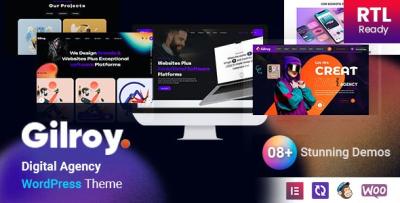
So I did the responsible thing (for once): instead of grabbing the first “Digital Agency” theme with a shiny demo, I built a quick comparison stack and tried several theme styles. I ended up spending the most time on Gilory – Digital Agency WordPress Theme because it sat in the uncomfortable middle ground agencies always need: looks creative, stays readable, and doesn’t fall apart when you add real projects.
This post is a first-person comparison written for people who actually build sites—agency owners, freelancers, and developers who want a theme that is:
-
easy to ship
-
easy to maintain
-
flexible without being chaotic
-
good for case studies and service pages
-
not embarrassing on mobile
What I compared Gilory against (same-category rivals)
When people say “digital agency WordPress theme,” they usually mean one of these approaches:
-
Minimal portfolio themes
Clean, lots of whitespace, often elegant. Sometimes too bare unless you have strong branding assets. -
Animation-first showcase themes
Big transitions, hover tricks, dramatic motion. Looks amazing in a demo. Can be fragile in production, especially on mobile. -
Multipurpose “everything” themes
Tons of widgets and demos. You can build anything—but you can also accidentally build a mess. -
Agency-specific themes
Themes that assume you need: services, process, team, testimonials, case studies, and a strong “contact us” flow.
Gilory feels closest to #4, but it borrows the best parts of #1 (clean) without becoming bland.
My criteria: what actually matters when an agency site must convert
I used a simple checklist that reflects real client projects:
A) Speed to a credible homepage
Can I get a homepage that looks like a real agency—not a “template demo”—in a few hours?
B) Case study UX
Do project pages feel like stories? Or like a gallery of screenshots?
C) Editing workflow
Can the client update copy, add a project, change a CTA, and not break the layout?
D) Mobile clarity
Does the site still feel premium on a phone, or does it become cramped and chaotic?
E) Performance baseline
Not “perfect Lighthouse scores,” but “feels snappy and not bloated.”
F) Consistency across pages
Services, About, Work, Blog—do they share a coherent visual system?
That’s the lens. Now here’s what I found.
The “demo illusion” problem (and how Gilory handled it)
Most themes look great in demos because demos are controlled environments:
-
perfect copy length
-
perfect images
-
perfect spacing
-
perfectly curated project screenshots
Reality is not like that.
Reality is:
-
one project has 2 images
-
one has 40
-
one has a PDF embedded as screenshots
-
one has a messy “before/after” situation
-
one has a client who doesn’t allow you to show much detail
So I stress-tested “messy content” on purpose.
Gilory’s project layout felt more forgiving than many animation-first themes, because it relies more on structure (spacing, hierarchy, typography rhythm) than on strict visual tricks. When a project had fewer images, it didn’t look empty. When a project had too many, it didn’t feel like an endless dump.
That sounds small, but it’s actually huge: your portfolio only looks premium if the template can handle imperfect content gracefully.
Gilory vs minimal portfolio themes (clean vs “too clean”)
Minimal themes win when:
-
you’re a designer with strong brand assets
-
you want ultra-simple pages
-
you’re okay building sections from scratch
But minimal themes often lose when:
-
you need to explain services clearly
-
you need a strong “process” narrative
-
you need to guide visitors toward contacting you
Gilory sits in a nicer middle:
-
it can look minimal and premium
-
but it doesn’t force you to invent everything
-
it supports service and process sections without feeling “corporate template-y”
My takeaway: Gilory feels like “minimal, but with agency structure.”
Gilory vs animation-first agency themes (wow vs long-term sanity)
Animation-first themes are fun until you ship them.
What I see in production:
-
mobile performance dips
-
touch interactions replace hover, and the design loses clarity
-
ongoing updates become harder
-
builders start layering optimization plugins to compensate
Gilory felt less dependent on heavy motion to feel modern. It can still be stylish, but the style doesn’t require your browser to do gymnastics.
If you’re an agency that updates its portfolio often, or you care about mobile experience, this matters.
Gilory vs multipurpose themes (flexibility vs design coherence)
Multipurpose themes are powerful, but they often create two problems:
-
Decision overload
So many widgets and options that you can accidentally make every section a different style. -
Template smell
You can build a decent site quickly, but it often looks like a “theme build” unless you customize heavily.
Gilory felt more coherent out of the box:
-
the typography scale looked consistent page to page
-
sections matched each other
-
spacing felt intentional
-
the whole site looked like one designed product
That coherence is what makes agency sites feel premium.
The real conversion flow: agency sites need “proof → process → next step”
Here’s a conversion structure I’ve seen work repeatedly:
-
Clear positioning (what you do and for whom)
-
Proof (work, results, testimonials)
-
Process (how you work so clients feel safe)
-
Fit filters (who you’re best for)
-
Next step CTA (book, message, inquiry)
Themes fail when they:
-
go too heavy on generic “services”
-
bury proof under too many clicks
-
lack a clear process page pattern
Gilory made it easy to assemble that structure without looking like a sales funnel. It’s persuasive without being noisy.
Case studies: where Gilory felt “agency-native”
For case studies, I care about:
-
a strong hero
-
clear roles (what you did)
-
constraints (what made it hard)
-
process (how you solved it)
-
outcomes (what improved)
-
visuals that support the story
A lot of themes treat “portfolio” as just a grid of images. That’s fine for artists. Agencies usually need narrative.
Gilory supports story-based project pages more naturally than typical gallery-first themes. And because it’s not overly animated, the content doesn’t get overshadowed by UI tricks.
Client handoff test: “Can they edit this without texting me weekly?”
This is my favorite brutal test:
-
If the client changes a title length, does the layout break?
-
If they add a paragraph, does spacing go weird?
-
If they upload a new image, does it crop badly?
-
If they add a new project, is it easy?
Gilory passed the “client-proofing” test better than many visually intense themes because the structure is simpler and more consistent. Fewer clever tricks means fewer fragile places.
The shop ecosystem tangent (why I care even for agencies)
Even agencies sometimes add:
-
digital products
-
paid templates
-
workshops
-
deposits for strategy calls
If you ever expand in that direction, it helps to know your theme ecosystem won’t fight you. That’s why I sometimes browse theme collections like WooCommerce Themes just to benchmark styling across product-oriented layouts while keeping a brand feel.
You might never sell anything. But thinking about it helps you choose a theme that won’t look awkward if you do.
Performance and “feels fast” (the practical view)
I won’t pretend any theme is fast if you upload 40 giant PNGs and 6 video embeds. But themes differ in:
-
how much unnecessary JS/CSS they load
-
how heavy their default UI elements are
-
whether they rely on motion to feel premium
Gilory felt like it can stay disciplined:
-
keep images optimized
-
avoid too many homepage animations
-
avoid stacking plugin “features” for no reason
It didn’t feel like the theme itself was working against me.
Common mistakes I saw in other agency themes (and how I avoided them)
Mistake #1: Making the homepage a museum
If everything is on the homepage, nothing is remembered. Gilory made it easier to create a homepage with curated highlights and push details into project pages.
Mistake #2: Overloading with “service cards”
Service cards aren’t bad, but too many look like an app directory. I used fewer, stronger service sections and let case studies do the persuasion.
Mistake #3: Portfolio grids that feel like eCommerce
Some themes style projects like products. Gilory’s presentation felt more editorial, which matches agency expectations.
Mistake #4: Using hover as a core interaction
Hover isn’t real on mobile. Gilory didn’t rely on hover to communicate navigation.
Who I’d recommend Gilory for (based on this comparison)
I’d recommend Gilory if you are:
-
a digital agency that needs a modern, premium site fast
-
a freelancer building a “studio” brand
-
someone who wants a portfolio that supports storytelling
-
someone who wants a theme that’s client-editable
When I’d choose something else
I’d look elsewhere if:
-
you want a super experimental, motion-heavy showcase site
-
you’re building a huge content magazine (not an agency)
-
you want a bare framework and plan to custom-design everything
Verdict: why Gilory stayed on my shortlist
After comparing it to other digital agency themes, Gilory stood out for one reason:
It looks designed without being fragile.
That’s the best compliment I can give a WordPress theme for agencies. You can make it premium, you can keep it coherent, and you can let your work speak—without the site becoming a high-maintenance art project.
-